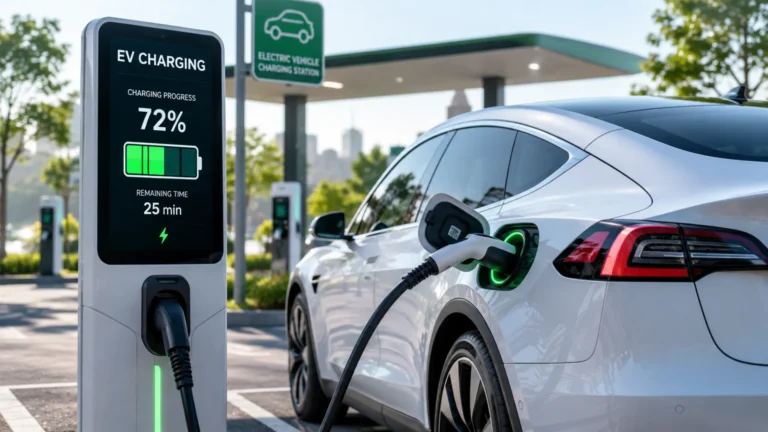
What is a hybrid car? Put simply, it’s a car with a gasoline engine and an electric motor that share the work. The result is better fuel economy and fewer emissions than a regular gas car. With fuel prices and the environment on many people’s minds, it’s no wonder more drivers are asking about them.
Hybrids sit somewhere between gas cars and fully electric ones, which is a big part of their appeal. Let’s go through how they work, what types you can buy, what’s good and bad about them, and whether you should get one.
What Is a Hybrid Car?
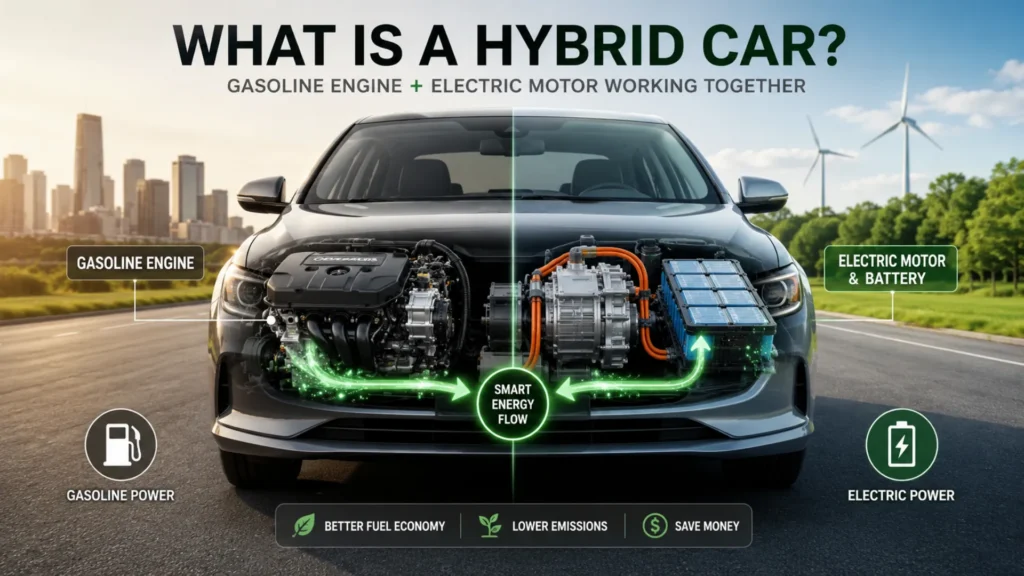
Simple Definition of a Hybrid Car
A hybrid uses two power sources to move the car: a gasoline engine and an electric motor. They work together so you burn less fuel.
A regular car runs only on gasoline. A hybrid vehicle can use electric power when it needs to, so you save fuel, cut emissions, and still drive it pretty much like any other car.
Why Hybrid Cars Were Created
Two problems pushed carmakers toward hybrids: fuel use and environmental impact.
They wanted a fuel-efficient car that could go farther on less gas and produce fewer harmful emissions. The modern hybrid gave drivers better efficiency without asking them to go fully electric.
How Does a Hybrid Car Work?
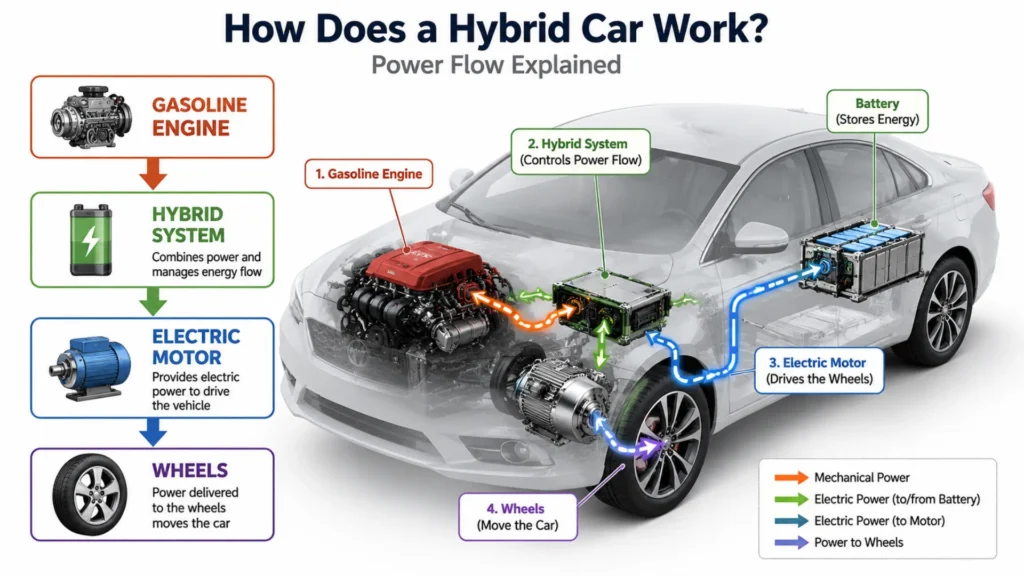
Main Components of a Hybrid Car
Under the hood, you’ll find a few main parts:
- Internal combustion engine (gasoline engine)
- Electric motor
- Hybrid battery pack
- Transmission system
Together, these parts deliver power while using less fuel.
What Happens While Driving?
You don’t have to do anything. The car decides which power source to use.
- Starting from a stop: It’ll often use the electric motor.
- Accelerating: The engine and motor may work together.
- Cruising: The gas engine usually handles steady speeds.
- Braking: The car recovers energy and stores it in the battery.
What Is Regenerative Braking?
When you brake in a regular car, that energy is mostly lost as heat. In a hybrid, regenerative braking turns some of it into electricity and stores it in the battery for later. Pretty clever, really.
Quick Fact: Many hybrids recharge their batteries automatically as you drive.
Types of Hybrid Cars Explained
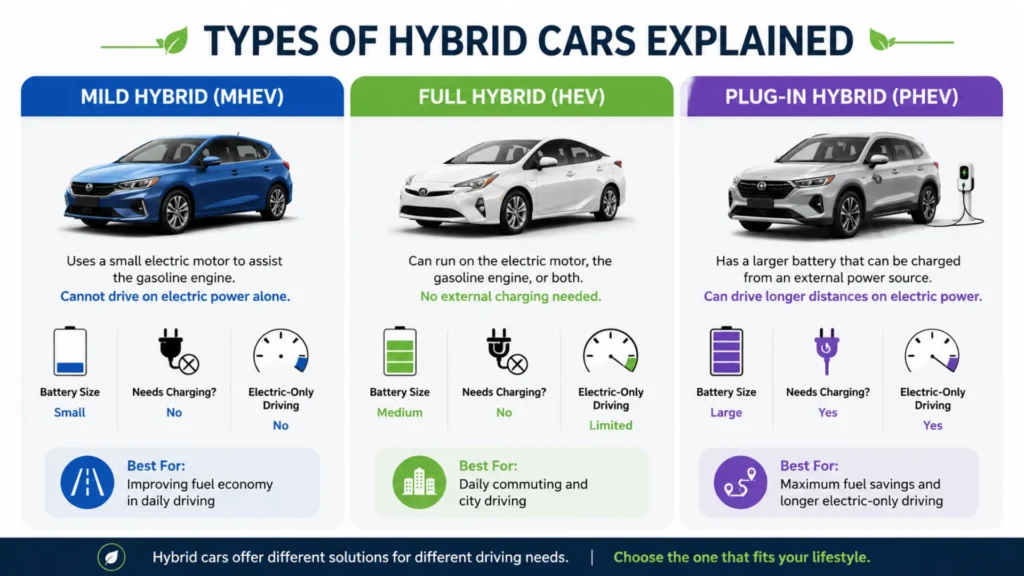
Mild Hybrid (MHEV)
A small electric motor helps the gas engine. It can’t move the car by itself, but it does improve fuel economy.
Full Hybrid (HEV)
This type can run on the electric motor, the gas engine, or both. You get excellent efficiency, and you never have to plug it in.
Plug-In Hybrid (PHEV)
This one has a bigger battery you charge from an electrical outlet. It can go much farther on electric power alone before switching to gas.
Comparison Table
| Type | Needs Charging? | Electric-Only Driving | Best For |
|---|---|---|---|
| Mild Hybrid (MHEV) | No | No | Improving fuel economy |
| Full Hybrid (HEV) | No | Limited | Daily commuting |
| Plug-In Hybrid (PHEV) | Yes | Yes | Maximum fuel savings |
Hybrid Car vs Gasoline Car
| Feature | Hybrid Car | Gasoline Car |
|---|---|---|
| Fuel Economy | Higher | Lower |
| Emissions | Lower | Higher |
| Fuel Costs | Lower | Higher |
| Maintenance | Slightly Complex | Simpler |
Key Takeaways
Choose a hybrid if you want better fuel efficiency and lower fuel bills.
A gas car may still suit you if you’d rather pay less upfront or prefer simpler systems.
Hybrid Car vs Electric Car
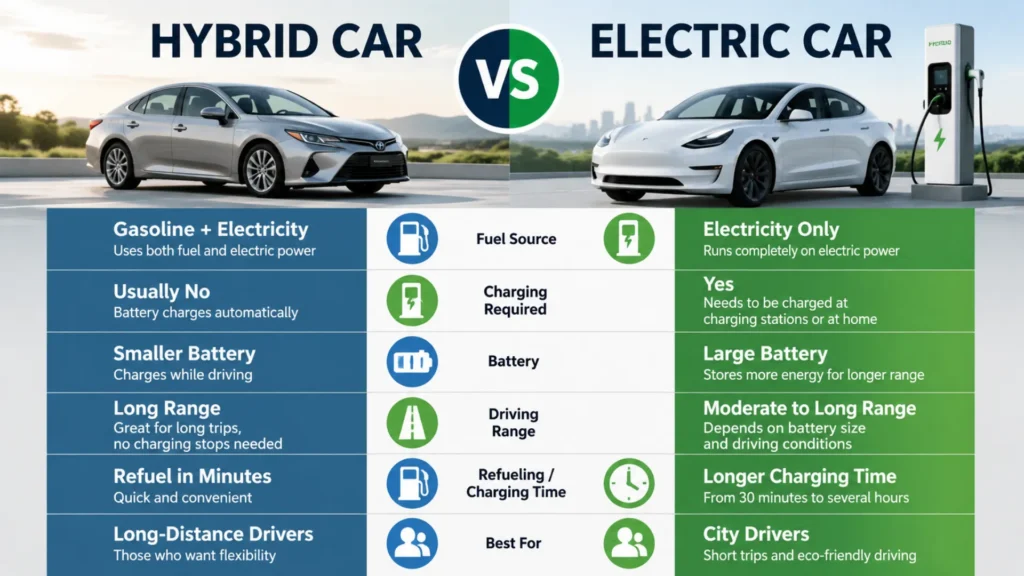
| Feature | Hybrid Car | Electric Car |
|---|---|---|
| Fuel Source | Gasoline + Electricity | Electricity Only |
| Charging Required | Usually No | Yes |
| Driving Range | Long | Depends on Battery |
| Running Cost | Low | Very Low |
Who Should Choose Which?
- City drivers: An electric car could be ideal.
- Long-distance drivers: A hybrid gives you more flexibility.
- First-time EV buyers: A hybrid makes for an easier step toward electric driving.
Advantages of Hybrid Cars
Benefits Include:
- Better fuel economy
- Lower fuel expenses
- Reduced emissions
- Quiet operation in low-speed driving
- Potential tax incentives in some regions
What about real savings? Many drivers save hundreds of dollars a year on fuel compared with a regular gas car.
Disadvantages of Hybrid Cars
Things to Consider
- Higher purchase price
- Battery replacement costs
- More complex powertrain systems
- Limited towing capability in some models
None of these are necessarily deal-breakers, but you should know about them before you buy.
How Much Money Can a Hybrid Car Save Per Year?
Example Savings Calculation
Let’s say you drive 15,000 miles a year.
A gas car averaging 25 MPG would use about 600 gallons. A hybrid averaging 50 MPG would use about 300, so you’ve cut your fuel use in half. Depending on local fuel prices, that could mean several hundred dollars a year.
Hybrid Car Battery Life and Replacement Cost
Key Questions Answered
Most hybrid batteries last between 8 and 15 years, depending on how the car’s used and maintained.
Replacement costs vary by model. Many manufacturers offer long battery warranties, so it may worry you less than you’d expect.
5 Common Myths About Hybrid Cars
Myth vs Fact
- Myth: Hybrid cars are slow.
Fact: Modern hybrids accelerate strongly. - Myth: The batteries fail quickly.
Fact: Most last many years. - Myth: Maintenance is expensive.
Fact: Many hybrids cost about the same to maintain as regular cars. - Myth: Hybrids can’t go long distances.
Fact: They’re excellent on long trips. - Myth: They’re difficult to repair.
Fact: Most dealerships and many repair shops can service them.
Who Should Buy a Hybrid Car?
Ideal Buyers
A hybrid could be a great fit for:
- Daily commuters
- Urban drivers
- Families
- Drivers looking for better fuel economy and lower operating costs
Frequently Asked Questions
Is a hybrid car worth buying?
It often is, especially if you drive regularly and want lower fuel costs and emissions.
Do hybrid cars need charging?
Most standard hybrids don’t, as they recharge while you drive. Plug-in hybrids do need charging.
How long do hybrid batteries last?
Typically between 8 and 15 years.
Are hybrid cars reliable?
Yes, modern hybrids are generally very reliable.
Do hybrid cars save money?
Yes. Many owners save money over time by burning less fuel.
Conclusion
So, what is a hybrid car? It’s a car that pairs a gas engine with an electric motor to use less fuel, cut emissions, and lower your fuel bill.
You’ll probably pay more upfront, and the system is more complex. Still, the long-term savings can make it worthwhile. Think about how you drive and what you can spend, and you should have a good idea of whether one makes sense for you.