How long does it take to charge an electric car? Anywhere from about 20 minutes to almost two days. That’s a huge range, but it really comes down to the size of the battery, the kind of charger you plug into, and the EV you drive.
Plug some modern EVs into a fast charger and they’ll gain hundreds of miles of range in under 30 minutes. Others need hours, or a whole night. Let’s look at what affects charging speed, what times to expect, and how to make charging easier.
How Long Does It Take to Charge an Electric Car?
Quick Answer
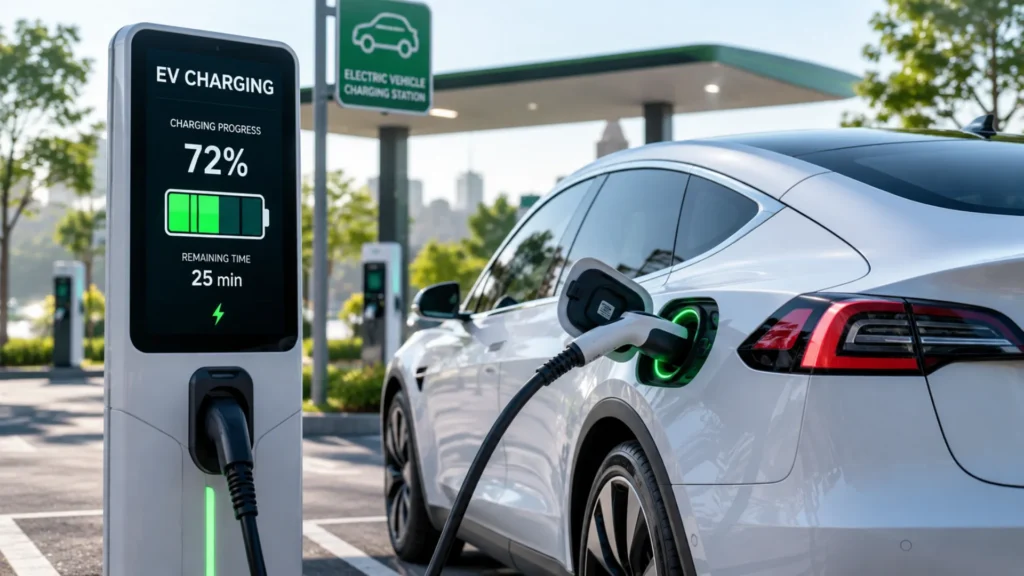
How long does it take to charge an electric car? Most take 4 to 10 hours on a Level 2 home charger, and a standard household outlet may need 20 to 40 hours. At a DC fast charging station, many EVs can go from 10% to 80% in as little as 20 to 60 minutes.
EV Charging Time Comparison Table
| Charger Type | Typical Charging Time |
|---|---|
| Level 1 Charger | 20–40 Hours |
| Level 2 Charger | 4–10 Hours |
| DC Fast Charger | 20–60 Minutes |
Key Takeaway
📌 Most EV owners just charge overnight at home with a Level 2 charger.
📌 DC fast charging can get many EVs to 80% in under an hour.
📌 Battery capacity, equipment, weather, and your car’s top charging speed all affect the time.
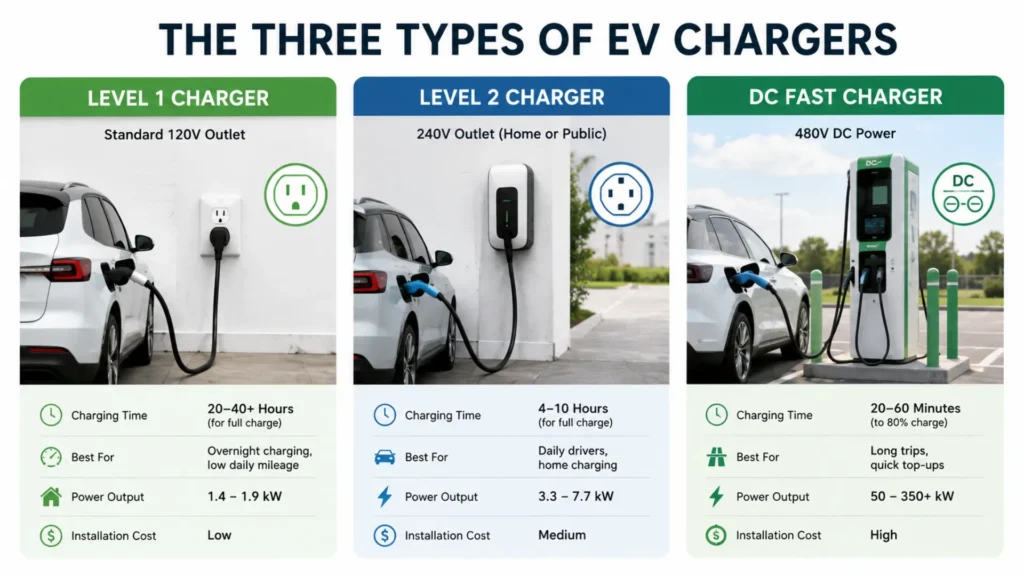
Understanding the Three Types of EV Chargers
The type of charger makes the biggest difference. It’s the gap between waiting less than an hour and waiting several.
Level 1 Charging (Standard Household Outlet)
Level 1 uses a regular 120V household outlet. It’s the slowest way of charging electric cars, adding roughly 3 to 5 miles of range per hour. That can still be fine if you have a short commute and can leave the car plugged in overnight.
Level 2 Charging
Level 2 chargers run on 240V, and you’ll find them in homes and workplaces. They often add 20 to 40 miles of range per hour. For most owners, that’s the sweet spot between convenience and speed.
DC Fast Charging
This is as fast as it gets. Found at public fast charging stations, these chargers can take many EVs from 10% to 80% in about 20 to 45 minutes. They really come into their own on road trips.
| Charging Level | Power Output | Best For |
|---|---|---|
| Level 1 | 120V | Overnight Charging |
| Level 2 | 240V | Daily Use |
| DC Fast | 400V–800V+ | Long Trips |
What Factors Affect Electric Car Charging Time?
Plug two EVs into the same station, and they may charge at very different speeds. Here’s why.
Battery Size
A bigger battery holds more energy, so it takes longer to fill. On the same charger, a 40 kWh battery will usually finish before an 80 kWh one.
Charger Power Output
The equipment matters too. A 7 kW Level 2 charger is slower than an 11 kW one, while DC fast charging stations can deliver 50 kW, 150 kW, or more. More power generally means faster charging.
Current Battery Percentage
EVs tend to charge fastest when the battery is low. At about 80%, the rate slows down to protect the battery and reduce heat.
Weather Conditions
Cold slows things down. Batteries work less efficiently in freezing weather, so winter charging often takes longer.
Vehicle Charging Limits
Your car has its own limit. If its maximum charging rate is 100 kW, plugging into a 150 kW fast charging station won’t make it any faster.
Remember: Battery size, battery temperature, state of charge, and the car’s maximum rate all play a part, so don’t be surprised if the car next to you charges faster.
How Long Does It Take to Charge Popular Electric Cars?
Every EV is different. Some can add hundreds of miles in under 30 minutes using DC fast charging, while others take longer. Here’s how a few popular models compare.
| Electric Car Model | Battery Size | Fast Charging Time (10–80%) |
|---|---|---|
| Tesla Model 3 | 75 kWh | 27 Minutes |
| Tesla Model Y | 81 kWh | 30 Minutes |
| Hyundai Ioniq 5 | 77.4 kWh | 18 Minutes |
| Kia EV6 | 77.4 kWh | 18 Minutes |
| Nissan Leaf | 60 kWh | 45 Minutes |
Why the differences? Each car has its own charging system and top speed. The Hyundai Ioniq 5 and Kia EV6, for example, use an 800-volt architecture that allows extremely fast charging at compatible stations. Cars with lower charging limits will need more time to reach the same level.
Battery size plays a part as well. Bigger batteries hold more energy, so they usually need longer sessions unless they can also charge at high speed.
How Long Does It Take to Charge an Electric Car at Home?
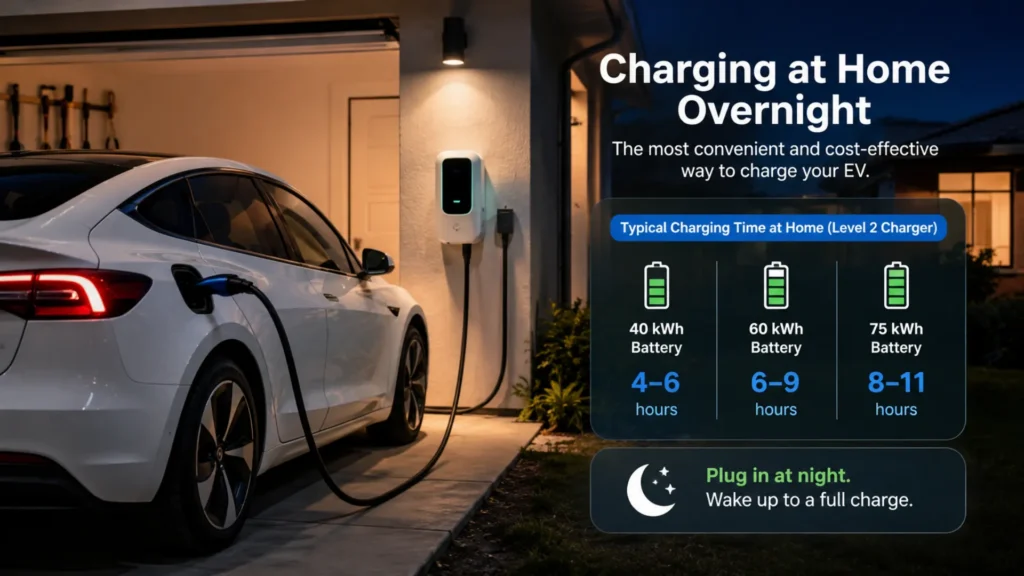
For most drivers, home EV charging is the easiest option. You plug in at night, and you wake up with a charged car. No trips to a station needed.
How long it takes depends on your charger and battery. A basic Level 1 charger can take 20 to 40 hours for a full charge. A Level 2 charger typically does it in about 4 to 10.
Example Scenario
Starting from empty takes longer than topping up from 40% or 50%, of course. And most days you won’t be starting from empty. You’ll just be replacing what you used, so it often takes far less time.
Quick Facts
- Average overnight charging time: 6–10 hours
- Most common home setup: Level 2 charger
- Charging at home is usually cheaper than using public fast charging stations
- Charging overnight may lower your costs in areas with off-peak electricity rates
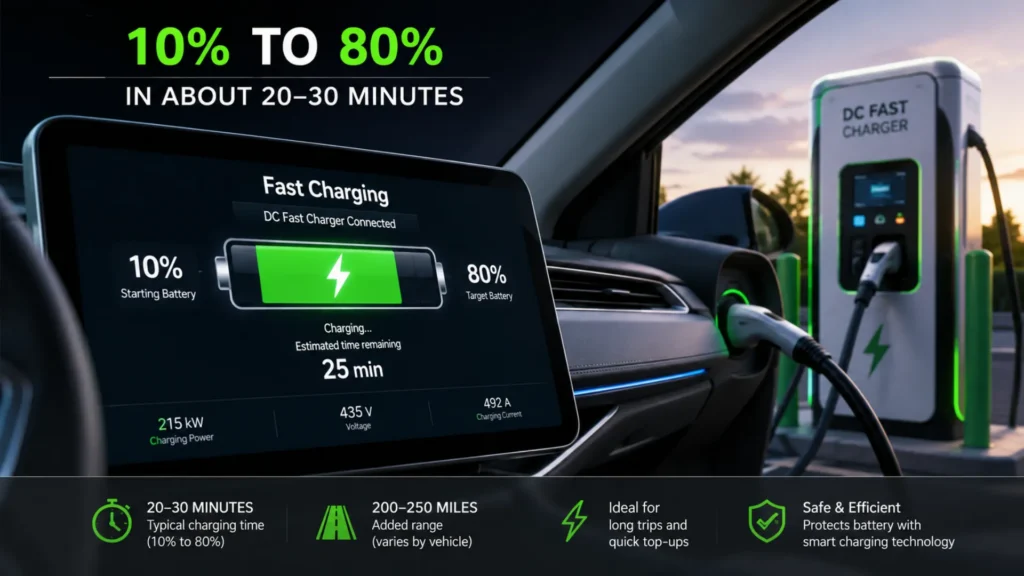
How Long Does Fast Charging Take?
Quick Answer
Most electric cars can go from 10% to 80% in about 20 to 45 minutes, depending on the vehicle, battery size, and charger power. That’s plenty of time for a coffee on a long trip.
What Is Fast Charging?
Fast charging, often called DC fast charging, uses high-powered stations to send electricity straight to the battery. It’s much quicker than a Level 1 or Level 2 charger, which makes it ideal for highway trips.
Typical Charging Times
| Charging Range | Average Time |
|---|---|
| 10% to 80% | 20–45 minutes |
| 20% to 80% | 15–35 minutes |
Most owners stop at 80%, because charging slows down a lot after that.
Why Most Drivers Stop at 80%
- It can help protect the battery’s long-term health.
- You’ll spend less time waiting at the station.
- Your road trip keeps moving.
Fast Charging Pros and Cons
Pros
- It’s very quick.
- It’s convenient on long trips.
- You’ll find it on many major routes.
Cons
- It usually costs more than home EV charging.
- Using it often may increase battery wear over time.
- Speed varies with the vehicle and weather.
How Much Range Can an Electric Car Gain Per Hour of Charging?
It depends on the charger. More power means more miles and less waiting.
| Charger Type | Range Added Per Hour |
|---|---|
| Level 1 Charger | 3–5 miles |
| Level 2 Charger | 20–40 miles |
| DC Fast Charging | 100–250+ miles |
Say you drive about 30 miles a day. A Level 2 charger can replace that in roughly an hour, so home EV charging works well for most commuters. Need a quick top-up on a long trip? That’s where DC fast charging stations come in.
Is It Better to Charge an EV to 80% or 100%?
For everyday driving, 80% is usually best. Stopping short of full can help reduce long-term battery wear, so many owners do this when charging at home.
Going to 100% makes sense before a long road trip, when you need all the range you can get. Just don’t leave it sitting at 100% for long periods.
Most manufacturers build in battery management systems and give charging recommendations. Check what yours says, because following it can help your battery last.
Common Electric Car Charging Mistakes to Avoid
A few common mistakes can slow your charging or shorten your battery’s life.
Mistake #1: Relying Only on Fast Charging
It’s convenient, but doing it all the time may increase battery wear.
Mistake #2: Letting the Battery Reach 0%
Regularly running it all the way down can hurt long-term battery health.
Mistake #3: Ignoring Cold Weather
Cold temperatures can slow charging and make it less efficient.
Mistake #4: Using the Wrong Equipment
Always use a compatible charger, or you may end up with slower charging.
Mistake #5: Charging to 100% Every Day
For most EVs, staying between 20% and 80% is better in the long run.
Frequently Asked Questions
How long does it take to fully charge an electric car?
It depends on your charger and battery size. Most EVs take 4 to 10 hours on Level 2, while DC fast charging can add significant range in 20 to 60 minutes.
Can I charge an electric car overnight?
Yes, and many owners do. It’s convenient and cost-effective.
How much does it cost to charge an EV?
It varies with electricity rates and battery size, but it’s usually cheaper than fueling a gas car.
Does fast charging damage the battery?
Occasional DC fast charging is generally safe. Relying on it all the time may increase long-term battery wear.
Which electric cars charge the fastest?
Models from Tesla, Hyundai, Kia, and Porsche are known for fast charging speeds.
How often should I charge my EV?
Most drivers charge as needed and keep the battery between 20% and 80%.
Conclusion
So, how long does it take to charge an electric car? Mainly, it depends on your charger and battery size. Level 1 can take a day or more, Level 2 usually works overnight, and DC fast charging can be done in under an hour.
Your driving habits, battery level, and weather all play a part too. For most people, a home charger handles the day-to-day, and fast chargers take care of the occasional long trip.