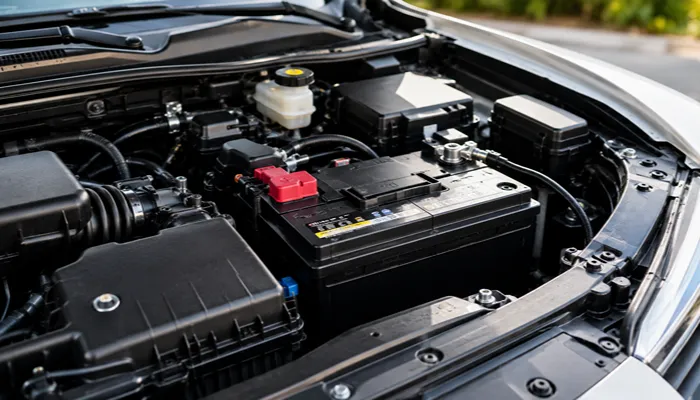
A car battery starts your engine and runs electrical systems like your lights, music, and air conditioning. Most of us never think about it until it fails, usually at the worst possible moment.
This guide should help you avoid that. We’ll cover how long a battery lasts, what voltage is normal, common problems and warning signs, and how to test, charge, and replace one.
What Is a Car Battery?
It’s a rechargeable box that stores electrical energy and provides the power to start your car. Without a working one, your car won’t start or run properly. It works together with the engine and charging system.

How a Car Battery Works
It stores electricity in chemical form and converts it to electrical energy when needed. When you turn the key or press the start button, the battery sends power to the starter motor, which gets the engine going.
After that, the alternator takes over and recharges the battery as you drive, so it’s ready for the next start.
Here’s the short version:
- The battery stores electrical energy
- The starter motor uses that energy to start the engine
- The alternator recharges the battery as you drive
Purpose of Car Battery
It does a lot more than start the engine. It also provides power to many of your car’s electrical parts.
It powers your:
- Headlights
- Dashboard lights
- Car radio and music system
- Power windows
- Air conditioning controls
- GPS and charging ports
It also helps keep electronic systems stable when the engine’s off or when you’re using a lot of electrical features.
Why Cars Need Batteries
Many important systems run on electricity, so even a gas car can’t function properly without a battery. It gives the initial power to start the engine and supports all the electrical parts.
When it gets weak or dies, you may notice:
- Slow engine start
- Dim headlights
- Clicking sounds when starting
- Electronics not working properly
Think of it as the heart of your car’s electrical system.

Types of Car Batteries
Each type works a little differently. Some are cheap and common, while others offer better performance, longer life, or faster charging. Here’s how to work out what suits your car.
Lead-acid Battery
This is the traditional type, and still the most common. It’s been around for years because it’s reliable and budget-friendly, using lead plates and sulfuric acid to create electricity.
It’s great for regular cars with basic electrical needs, and it’s easy to find and replace. On the other hand, it may need more maintenance and may not last as long as newer types.
Pros:
- Affordable price
- Easily available
- Reliable for daily use
Cons:
- Shorter lifespan
- Requires maintenance in some models
- Less efficient in extreme weather
AGM Battery
AGM stands for Absorbent Glass Mat. It’s a step up from standard lead-acid, designed for modern cars with extra electronics, start-stop systems, and higher power demands.
It charges faster and lasts longer than a traditional battery. It’s also sealed, so you don’t have to worry so much about leaks or maintenance.
Pros:
- Longer battery life
- Faster charging
- Better performance in cold weather
- Maintenance-free
Cons:
- More expensive
- Sensitive to overcharging
Lithium-ion Battery
You’ll mostly find these in electric and hybrid vehicles. They’re light, very efficient, and can store more energy in less space.
All that technology makes them expensive, but they offer excellent durability and fast charging.
Pros:
- Lightweight design
- Long lifespan
- Fast charging
- High energy efficiency
Cons:
- Expensive
- Requires special battery management systems
Gel Battery
These sealed batteries use gel instead of liquid acid. They’re built to handle deep discharge cycles and rough conditions.
They’re common in motorcycles, marine vehicles, and backup power systems, and they resist spills and vibration.
Pros:
- Spill-proof design
- Good for deep cycling
- Low maintenance
Cons:
- Higher cost than standard lead-acid batteries
- Slower charging speed
| Battery Type | Lifespan | Maintenance | Cost | Best For |
|---|---|---|---|---|
| Lead-acid | Moderate | Medium | Low | Regular cars |
| AGM | Long | Low | Medium-High | Modern vehicles |
| Lithium-ion | Very Long | Low | High | Electric vehicles |
| Gel | Long | Low | Medium | Marine & backup systems |
How Long Does a Car Battery Last?
Usually 3 to 5 years, but that can change. Some stop working sooner, while others go on longer with good care. If your car’s starting slowly or having electrical problems, your battery may be getting weak.

Average Lifespan
Most modern batteries are designed to last around 3 to 5 years. How often you drive, your local weather, and maintenance can all change that.
Here’s a quick overview:
| Condition | Expected Battery Life |
|---|---|
| Normal driving conditions | 3–5 years |
| Hot climate areas | 2–4 years |
| Cold climate areas | 3–5 years |
| Poor maintenance | Shorter lifespan |
Weather Effects
Weather has a big effect on battery health.
- Hot weather can make battery fluid evaporate faster, damaging the internal parts.
- Cold weather slows the chemical reactions inside, so it’s harder to start the engine.
That’s why so many people have battery trouble in extreme summer or winter.
Driving Habits Matter
Your daily routine counts as well.
These habits can weaken a battery:
- Taking only short trips regularly
- Leaving lights or electronics on
- Not driving the car for long periods
- Frequently using heavy electrical accessories
Longer drives, on the other hand, help recharge the battery properly.
Signs of an Aging Battery
An old battery usually gives you some warning before it fails.
Look out for these symptoms:
- Slow engine start
- Dim headlights
- Clicking sound when starting the car
- Dashboard battery warning light
- Electrical features not working properly
- Battery swelling or corrosion
Notice any of these? Test or replace your battery before it leaves you stranded.

Signs of a Bad or Weak Car Battery
Catch these signs early, and you may avoid being stuck with a car that won’t start.
Slow Engine Crank
This is often one of the first signs. The engine takes longer than normal to start when you turn the key or press the button.
You may notice:
- The engine sounds weak while starting
- The car struggles to turn over
- Starting becomes harder in cold weather
Your battery’s probably losing power, and it may need charging or replacing soon.
Dashboard Warning
Many modern cars show a battery warning light when there’s a charging or battery problem.
You might see:
- Battery-shaped warning light
- Flickering dashboard lights
- Warning messages related to charging system
The alternator may be involved too, so have the battery and charging system checked together.
Dim Lights
Since the battery powers the electrical system, low power can affect how bright your lights are.
You may notice:
- Headlights look weaker than usual
- Interior lights appear dim
- Lights become brighter after revving the engine
If this keeps happening, your battery may not be holding a proper charge.
Clicking Sound
Hear clicking when you try to start the car? The battery may not have enough power to turn the engine over.
It can happen when:
- The battery is nearly dead
- Battery connections are loose or dirty
- The battery is old and worn out
Rapid clicking is a strong sign your battery needs attention.
Electrical Issues
A weak battery can cause all sorts of random electrical problems.
Some common ones are:
- Power windows moving slowly
- Radio or touchscreen not working properly
- AC system acting weak
- Phone chargers or USB ports not working consistently
If several of these happen at once, the battery could be the main cause.
How Many Volts Is a Car Battery?
A standard car battery is 12 volts, though the actual reading changes with its condition and whether the engine’s running.
Normal Voltage
With the car off, a healthy battery usually reads around 12.4 to 12.7 volts. That’s enough to start the car and run basic electrical systems.
Fully Charged Voltage
Fully charged, it should read about 12.6 to 12.8 volts on a multimeter. With the engine running, it may rise to around 13.7 to 14.7 volts, since the alternator’s charging it.
Low Voltage Warning
Below 12.4 volts, it may start losing performance. Under 12 volts often means it’s weak or needs charging. And below 11.8 volts, the car may have trouble starting.
Car Battery Voltage Chart
| Battery Voltage | Battery Condition |
|---|---|
| 12.6V – 12.8V | Fully charged |
| 12.4V – 12.5V | Normal / healthy |
| 12.2V – 12.3V | Partially charged |
| 12.0V – 12.1V | Low battery |
| Below 11.8V | Very low / may not start |
A regular voltage check can help you avoid starting problems, and it can tell you when it’s time to charge or replace the battery.
How to Test a Car Battery
It’s easier than many people think, and you can do it at home with simple tools. A regular test could save you from a sudden breakdown and an expensive repair.
Using Multimeter
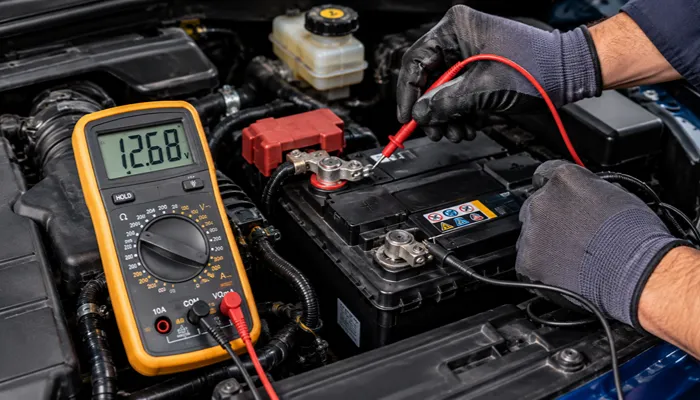
This is one of the easiest and most accurate tools for the job. It measures your battery’s voltage, which tells you about its condition.

Follow these steps:
- Turn off the car engine and remove the keys.
- Open the hood and locate the car battery.
- Set the multimeter to DC voltage (20V setting).
- Connect the red probe to the positive (+) terminal.
- Connect the black probe to the negative (-) terminal.
- Check the reading on the screen.
Here’s what your reading usually means:
| Voltage Reading | Battery Condition |
|---|---|
| 12.6V or higher | Fully charged |
| 12.4V – 12.5V | Good condition |
| 12.0V – 12.3V | Low charge |
| Below 12V | Weak or failing battery |
If it’s low, recharge the battery and test it again.
Home Testing
You can also do a basic test without any equipment. Start the car, and pay attention to these signs:
- Engine cranks slowly
- Headlights look dim
- Dashboard lights flicker
- Clicking sound when starting the car
These often point to a weak battery. Here’s another easy check: turn on the headlights with the engine off. If they get weak quickly, your battery may not be holding a charge.
Safety Tips
Be careful around your battery, since it contains acid and electrical power.
Keep these tips in mind:
- Wear gloves and safety glasses
- Never touch both terminals together with metal objects
- Keep sparks and flames away from the battery
- Make sure the car is turned off before testing
- Clean battery terminals carefully if there is corrosion
These simple precautions can help prevent accidents and damage.
Professional Testing
Still not sure? Go to a mechanic or auto repair shop. They’ll use advanced testers to check your:
- Battery health
- Charging capacity
- Cold cranking amps (CCA)
- Alternator performance
This is especially useful if your battery keeps dying after charging, since it can reveal hidden electrical problems that are hard to find at home.

Common Car Battery Problems
Batteries can fail for many reasons. Here are some of the most common problems, so you can deal with them before they get serious.
Dead Battery
This happens when the battery loses its charge completely. Leaving your headlights on, not driving for a long time, or simply having an old battery can cause it. If your car won’t start or you hear clicking when you turn the key, it may be dead.
Corrosion
This shows up as a white, blue, or green powder around the terminals. It can block the flow of electricity and make starting harder. Battery acid leaks and moisture buildup often cause it, so clean the terminals regularly.
Loose Terminals
They can stop power from getting where it needs to go. You might notice flickering lights, trouble starting, or random electrical problems. Vibration from driving can loosen them over time.
Alternator Problems
Sometimes, the battery isn’t the real problem. The alternator charges it while the engine runs, so if the alternator fails, even a new battery will slowly lose power. Dashboard warning lights or dim headlights can be signs.
Overcharging
This happens when too much voltage reaches the battery, causing it to overheat, swell, or lose fluid quickly. A faulty voltage regulator is often to blame. Ignore it, and you could shorten the battery’s life and damage other electrical parts.

How to Charge a Car Battery
Dead batteries happen, especially if the car’s been sitting for a long time or you left the lights on. Fortunately, charging one isn’t very hard. You just need the right tools and some care.
Using Charger
A battery charger is the safest way. Turn the car off and open the hood, then find the terminals. Red is usually positive (+), and black is usually negative (-).
Then follow these steps:
- Connect the red charger clamp to the positive terminal.
- Connect the black clamp to the negative terminal.
- Plug in the charger and select the correct charging mode.
- Let the battery charge fully before you disconnect the charger.
A slow charge is usually better, since it helps protect the battery.
Jump Start Basics
Need quick power to start the car? A jump start can help. You’ll need jumper cables and another car with a working battery.
Here’s the basic process:
- Park both cars close together.
- Connect the positive cable to both positive terminals.
- Connect the negative cable to the working battery first.
- Attach the other negative end to an unpainted metal part of the dead car.
Start the working car first, then try the car with the dead battery. Once it starts, let the engine run for a while to recharge the battery.
Charging Time
It depends on the battery size and the charger. A normal car battery may take:
| Charger Type | Approximate Time |
|---|---|
| Slow charger | 6–12 hours |
| Fast charger | 1–3 hours |
Fast charging is convenient, but using it too often may shorten battery life.
Safety Precautions
Before you charge a battery, think about safety.
Important safety tips:
- Wear gloves and safety glasses.
- Keep sparks and flames away from the battery.
- Charge the battery in a ventilated area.
- Never connect the terminals incorrectly.
- Stop immediately if the battery leaks or smells strange.
These precautions can help you charge your battery safely and avoid damaging your car.

How to Replace a Car Battery
It’s a simple DIY job if you follow the steps carefully. On most cars, it takes around 20 to 30 minutes, and you’ll save on mechanic charges.
Tools Required
Have these ready before you start:
- Safety gloves
- Safety glasses
- Wrench or socket set
- Battery cleaning brush
- Anti-corrosion spray (optional)
- New car battery
Make sure the new battery matches your car’s size and power requirements.
Removal Steps
Follow these steps to remove the old battery safely:
- Turn off the engine completely and remove the keys from the ignition.
- Open the hood and locate the battery.
- Disconnect the negative terminal first (usually black with a “-” sign).
- Next, disconnect the positive terminal (usually red with a “+” sign).
- Remove the battery hold-down clamp or bracket.
- Carefully lift the old battery out of the tray. It’ll be heavy, so use both hands.
See corrosion around the terminals? Clean it off with a battery brush before you install the new one.
Installation Process
Now put the new one in:
- Place the new battery into the tray in the correct position.
- Secure it using the hold-down clamp.
- Connect the positive terminal first.
- Then connect the negative terminal.
- Tighten the connections, and make sure the battery can’t move.
- Start the car and check if everything works normally.
Getting this right can help prevent electrical problems and help your battery last.
Safety Tips
Keep these in mind while you work:
- Never touch both terminals with metal tools at the same time.
- Wear gloves and eye protection.
- Keep sparks and flames away from the battery.
- Do not force terminal connections.
- Dispose of the old battery at a recycling center or auto parts store.
Cost Estimate
It depends on the battery type and your vehicle.
| Item | Estimated Cost |
|---|---|
| Standard car battery | $80–$150 |
| Premium battery | $150–$300 |
| DIY replacement cost | Usually free |
| Mechanic installation | $20–$80 |
Do it yourself and you’ll save on labor, and you’ll have learned a useful skill too.
How Much Does a Car Battery Cost?
It varies with your vehicle, battery size, brand, and warranty. Most drivers spend between $80 and $250. Luxury cars, trucks, and cars with start-stop systems may need something pricier.
Average Price
For a small or mid-size car, you’ll usually pay around $100 to $180. An SUV, truck, or premium vehicle may cost more, since it often needs a more powerful battery.
Budget vs Premium
Budget batteries are cheaper and fine for basic daily driving. They usually come with shorter warranties and may not last as long in extreme weather.
Premium batteries cost more, but you often get:
- Longer lifespan
- Better performance in hot or cold weather
- Stronger starting power
- Longer warranty coverage
Planning to keep your car for several years? Spending a little more now could save you money later.
| Battery Type | Average Cost | Best For | Warranty |
|---|---|---|---|
| Budget Battery | $80–$120 | Basic daily driving | 1–2 years |
| Mid-Range Battery | $120–$180 | Most standard vehicles | 2–3 years |
| Premium Battery | $180–$250+ | Luxury cars & heavy use | 3–5 years |
Installation Cost
Some shops will install it for free if you buy from them. Otherwise, it usually costs $20 to $50. Luxury or hard-to-reach setups may cost more, since they take longer.
Warranty Considerations
Always read the warranty before you buy. A longer one often means better quality. Some offer free replacement, while others only give partial coverage after a certain time, so read the details.

Car Battery Maintenance Tips
A little care can help your battery last longer and spare you a sudden breakdown.
Cleaning Terminals
Terminals collect dirt, dust, and corrosion over time. That buildup can weaken the connection and make it harder to start your car.
Here’s how to clean them:
- Turn off the car before cleaning.
- Check for white or green powder around the terminals.
- Use a soft brush with a mix of baking soda and water to remove corrosion.
- Wipe the terminals dry with a clean cloth.
Clean terminals help maintain a strong electrical connection.
Preventing Battery Drain
It’s easy to drain your battery by accident. Leaving headlights, cabin lights, or charging devices on can slowly weaken it.
To avoid this:
- Turn off lights when leaving the car.
- Unplug phone chargers and accessories.
- Start your car regularly if it is parked for long periods.
- Make sure doors and the trunk are fully closed.
Small habits like these can make a real difference.
Charging Habits
Short drives may not give the battery enough time to fully recharge, so good habits matter.
Try to:
- Take longer drives occasionally.
- Avoid overusing electronics while the engine is off.
- Use a proper charger if the battery becomes weak.
- Check the charging system during regular servicing.
Keep it charged, and it’ll be stronger and more reliable.
Seasonal Care Tips
Hot summers and cold winters both put extra stress on a battery.
| Season | Battery Care Tip |
|---|---|
| Summer | Park in shade to reduce heat damage |
| Winter | Start the car regularly to maintain charge |
A bit of care all year round can help it perform better and last longer.
Best Car Battery Brands

Which brand should you buy? Some focus on affordability, while others are known for long life and premium quality. It really depends on your budget, driving habits, and vehicle.
Popular Brands
Some of the most trusted names include:
- Amaron: Known for reliability and low maintenance
- Exide: One of the most common and widely available options
- Bosch: Popular for premium performance and durability
- ACDelco: Trusted for strong starting power
- Optima: Famous for high-end AGM batteries
Best Budget Option
For a good balance of price and performance, look at Exide and Amaron. They’re easy to find, work well for daily driving, and usually come with decent warranty support.
Best Premium Option
Bosch and Optima are strong choices here, designed for modern vehicles, SUVs, and cars with heavy electrical use. They often last longer and do better in extreme temperatures.
Longest Lasting Brands
Amaron and Optima are often considered among the longest lasting. AGM batteries from premium brands also tend to outlast standard ones.
| Brand | Best For | Price Range | Average Lifespan |
|---|---|---|---|
| Amaron | Long life & reliability | Medium | 4–6 years |
| Exide | Budget-friendly use | Affordable | 3–5 years |
| Bosch | Premium performance | High | 4–6 years |
| ACDelco | Strong starting power | Medium | 3–5 years |
| Optima | High-end AGM batteries | Premium | 5–7 years |
Frequently Asked Questions
Can I replace a car battery myself?
Yes, and many people do. It’s usually simple if you follow the safety steps and have basic tools and the right battery. Disconnect the negative terminal first, and reconnect it last.
How long does a car battery usually last?
Most last around 3 to 5 years, depending on your driving, the weather, and maintenance.
Can a dead battery be charged again?
Sometimes. If it’s only discharged, a charger or jump start may revive it. If it’s old or internally damaged, you’ll probably need a new one.
Is it safe to drive with a weak battery?
It’s risky. The car might not start at any time, and it can affect electrical systems and strain the alternator. Replacing it early is usually safer.
How can I keep my car battery healthy?
A few habits can help:
- Driving the car regularly
- Turning off lights and electronics when not needed
- Cleaning battery terminals
- Avoiding extreme temperatures when possible
- Testing the battery during regular car service
Conclusion
A car battery is easy to forget about, right up until it fails. Most last 3 to 5 years, and the warning signs usually show up first: slow starts, dim lights, and clicking.
Keep the terminals clean, drive regularly, and test the battery from time to time. When it’s time for a new one, you now know what to buy, what to pay, and how to put it in.
